
Canadian mortgage markets are beginning to reflect rising global tensions and renewed inflation concerns. The Government of Canada 5-year bond yield, the key benchmark used to price fixed mortgage rates, has been trending higher in recent weeks as investors respond to geopolitical risk and the possibility of rising energy costs.
• Mortgage rates and other borrowing costs are influenced by the BoC’s policy rate: keeping it unchanged supports stability in borrowing costs for consumers and businesses for the near term.
As of March 9, the 5-year Government of Canada bond yield sits around 2.909%, near the upper end of its recent trading range and approaching the 3% level markets briefly touched in late 2025.
Why Bond Yields Matter for Mortgage Rates
In Canada, most borrowers choose a five-year fixed mortgage, and lenders use the 5-year Government of Canada bond yield as the main benchmark for pricing those mortgages.
When bond yields rise, lenders’ funding costs increase. Mortgage rates are usually 1% – 2% higher than the bond yield, depending on market competition and lender risk tolerance. With bond yields now approaching 2.9% – 3.0%, lenders may face pressure to increase fixed mortgage rates if the trend continues.
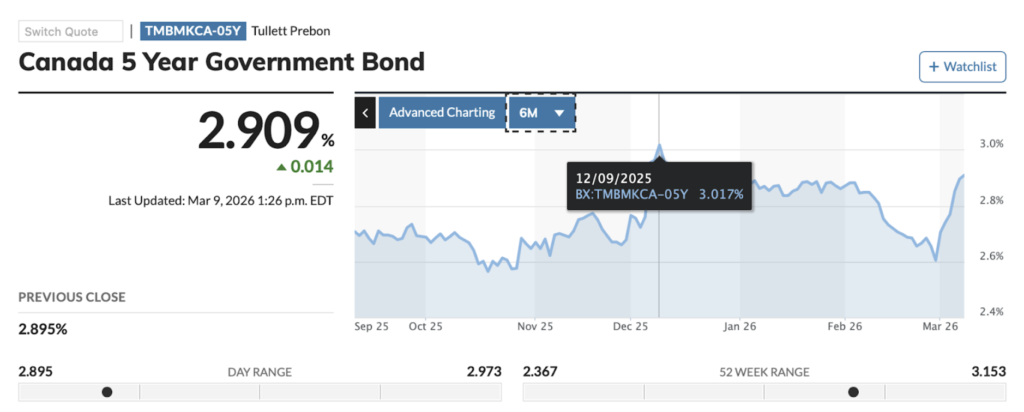
What the Chart Shows
Looking at the past six months of bond market activity, several trends stand out:
• The yield dipped to roughly 2.55–2.60% in late 2025
• It spiked above 3.0% in December
• It declined again early in 2026
• Recent weeks have shown a sharp rebound back toward 3%
This movement highlights how quickly bond markets react to changing economic expectations. Bond yields typically rise when investors believe inflation could increase, because they demand higher returns to offset the loss of purchasing power over time.
Why the Iran Conflict Matters
Growing tensions involving Iran have increased concerns about disruptions to global oil supply. A major risk point is the Strait of Hormuz, one of the world’s most critical energy shipping routes where roughly 20% of global oil supply passes each day. If conflict escalates or supply is disrupted, oil prices could rise significantly. Higher energy prices tend to push overall inflation higher, which is exactly what bond markets are beginning to price in. Hopefully, this situation will resolve itself in the short term, in which case rates should continue to drop.
The Bottom Line
The recent climb in Canada’s 5-year bond yield toward 3% is a reminder that mortgage rates are influenced by global economic forces—not just domestic policy decisions. Events around the world, including tensions in the Middle East and movements in global oil markets, can quickly ripple through financial markets and ultimately affect the cost of borrowing for Canadian homeowners.
We can lock in rates for 120-130 days, so if you are thinking about buying a home or renewing your mortgage, we suggest reaching out to us sooner rather than later.
Get In Touch
If you’re thinking about a new mortgage or renewing your current one, let’s chat and explore your options. With over 50 years of combined experience, we are here to help you navigate the mortgage landscape. Connect with a 4Front broker today.